
Equestrians have always felt their horses somehow know when they need a friend. Now, science has proven that horses can indeed tell our moods by facial expression. The study, conducted by a team at the University of Sussex in England, provides the first evidence that horses have the ability to discriminate between positive (happy) and negative (angry) human facial expressions in photographs, the University reported early this week.
The Study
The horses used in the study were all domesticated, taken from five riding stables in the Sussex and Surrey areas of the United Kingdom between April 2014 and February 2015. The final sample was 28 horses: 21 gelding, 7 mares, ranging in age from 4 to 23 years.
The study used large, A3 size laminated photographs of two models mounted on a poster board with either a happy or angry image.
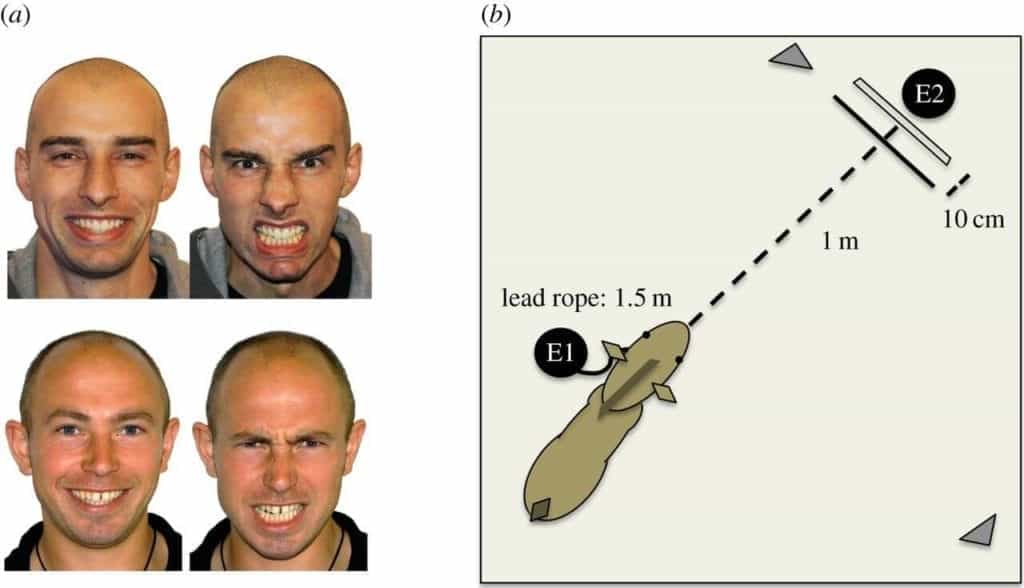
The experiment was conducted by a team of female researchers. Each horse was shown two images – one happy and one angry – while the team measured its behavioral and physiological (HR) responses. According to their report:
“It was expected that negative stimuli would induce avoidance behaviour and a left-gaze bias, whereas positive stimuli would induce approach behaviour and either a right-gaze bias or no bias. Moreover, horses' HRs were expected to be higher, to increase faster and to require longer recovery periods in response to negative stimuli.” (rsbl.royalsocietypublising.org)
The Results
The team found that horses responded “correctly” to happy and angry facial expressions, implying that they can read human emotions.
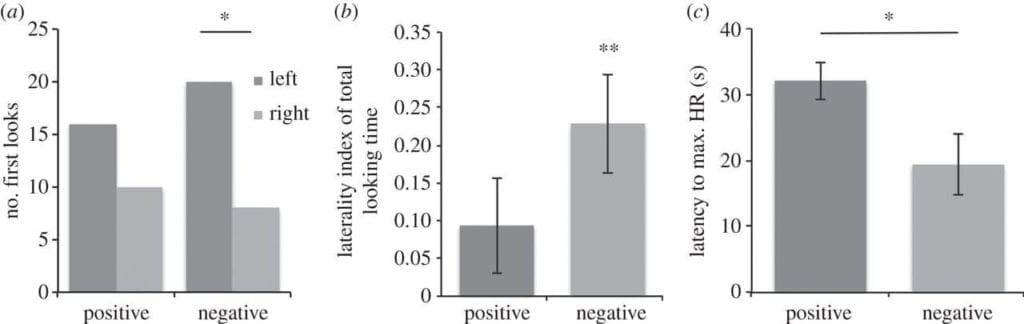
According to the report:
“Our results showed that the angry faces induced responses indicative of a functional understanding of the stimuli: horses displayed a left-gaze bias (a lateralization generally associated with stimuli perceived as negative) and a quicker increase in heart rate (HR) towards these photographs. Such lateralized responses towards human emotion have previously only been documented in dogs, and effects of facial expressions on HR have not been shown in any heterospecific studies. Alongside the insights that these findings provide into interspecific communication, they raise interesting questions about the generality and adaptiveness of emotional expression and perception across species.”
In an interview for the school’s website, Amy Smith, a doctoral student in the Mammal Vocal Communication and Cognition Research Group at Sussex who co-led the research, said:
“What’s really interesting about this research is that it shows that horses have the ability to read emotions across the species barrier. We have known for a long time that horses are a socially sophisticated species but this is the first time we have seen that they can distinguish between positive and negative human facial expressions. The reaction to the angry facial expressions was particularly clear – there was a quicker increase in their heart rate, and the horses moved their heads to look at the angry faces with their left eye.”
In addition, they found that the response to the negative stimuli was greater than the response to the positive one. This could be because it’s more important for animals (especially prey animals) to recognize a threat in their environment over a friendly presence.
Of course, this study doesn’t explain why horses can ready human emotions. In the same interview, Profession Karen McComb, co-lead author of the research, said this:
Horse Courses by Elaine Heney
- Listening to the Horse - The Documentary by Elaine Heney & Grey Pony Films
- Shoulder In & Out Training for better balance, bend & topline development with your horse
- Over 110+ Polework Exercises & Challenges to Download
- Dancing at Liberty & Creating Connection with Your Horse (11 lessons) - Grey Pony Films
“There are several possible explanations for our findings. Horses may have adapted an ancestral ability for reading emotional cues in other horses to respond appropriately to human facial expressions during their co-evolution.
Alternatively, individual horses may have learned to interpret human expressions during their own lifetime. What’s interesting is that accurate assessment of a negative emotion is possible across the species barrier despite the dramatic difference in facial morphology between horses and humans.”
The team will continue their research, which was part of an ongoing project on emotional awareness in horses funded by the Leverhulme Trust and the University of Sussex.




Leave a Reply